Charles B Fitzsimons was a man who seemed to move through Hollywood by opening doors rather than standing in front of them. Actor, attorney, producer, production executive, and longtime leader of the Producers Guild of America, he built a career that crossed several worlds of the entertainment business. Born Charles Bernard FitzSimons on May 8, 1924, in Ranelagh, County Dublin, Ireland, he belonged to an unusually artistic family whose members found their way into acting, music, religious life, and the theatre.
His story is also inseparable from that of his famous younger sister, Maureen O’Hara. Yet Charles developed an identity of his own. His career stretched from the Abbey Theatre and John Ford’s The Quiet Man to television production and nearly two decades of leadership at the Producers Guild of America. He died in Los Angeles on February 14, 2001, at the age of 76.
An Artistic Family in Dublin
Charles was one of six children born to Charles Stewart Parnell FitzSimons and Marguerita Lilburn FitzSimons. The family lived in a middle class Catholic environment in Dublin where music, drama, dance, and performance were encouraged.
His father, Charles Stewart Parnell FitzSimons, was born in Kells, County Meath, in 1885. He worked in Dublin business, including employment connected with the clothing trade, and was also associated with Shamrock Rovers football club. His later life took him to the United States, where he died in Los Angeles in 1972.
His mother, Marguerita, known as Rita or Marguerite, was born in Dublin in 1898. She was an accomplished contralto singer, and music became an important thread running through the family. Her own family background included her father James Lilburn, a Dublin Metropolitan Police constable, and her mother Margaret Blythe.
The FitzSimons household was almost like a small conservatory of talent. Several of the children became performers, while another entered religious life.
Charles Fitzsimons and His Siblings
The six FitzSimons children followed very different paths, although the stage remained a recurring presence in their lives.
| Family member | Known for | Years |
|---|---|---|
| Peggy FitzSimons | Religious life and music | c. 1918 to 2013 |
| Maureen O’Hara | Film acting | 1920 to 2015 |
| Clare Florence Catherine Hamilton | Acting | c. 1920s to late 1990s |
| Charles Bernard FitzSimons | Acting, law, production, guild leadership | 1924 to 2001 |
| Margot FitzSimons Edwards | Acting | 1926 to 2014 |
| James O’Hara | Film and television acting | 1927 to 1992 |
Peggy, the oldest, became a Sister of Charity, Sister Mary Margaret. Her excellent soprano voice earned her a La Scala opportunity when she was young. She became religious rather than theatrical.
Maureen O’Hara was the family’s most famous member. Born Maureen FitzSimons in 1920, she had a successful Hollywood career, particularly in The Quiet Man and How Green Was My Valley. Charles became her attorney and supervised her professional affairs.
Clare (Florence Catherine) took up acting and featured in Hotel Reserve with James Mason in 1944. She was affiliated with the Abbey Theater but chose family over acting.
Margot FitzSimons Edwards starred in I Know Where I’m Going! and The Captive Heart. She married Marine Major Harry W. Edwards and lived in Wilmington, North Carolina.
Other actors included James Lilburn FitzSimons, known as James O’Hara. He appears in The Quiet Man, What Price Glory, Titanic, and The Desert Rats.
Education and the Abbey Theatre
Charles did not enter the entertainment business without another professional foundation beneath him. He studied at the National University of Ireland, earning a Bachelor of Arts in legal, political, and economic science with exceptionally high academic results.
He continued his legal education at King’s Inns and completed his Barrister-at-Law degree at only 20. Because of the rules governing legal practice, he waited until he was 21 before practicing.
At the same time, theatre remained part of his life. He trained and performed with Dublin’s Abbey Theatre, giving him practical experience in the world that would eventually become his professional home.
This combination of law and theatre proved unusually useful. Charles understood contracts and legal matters, but he also understood performers, directors, scripts, production pressures, and the unpredictable machinery of filmmaking.
Working With John Ford on The Quiet Man
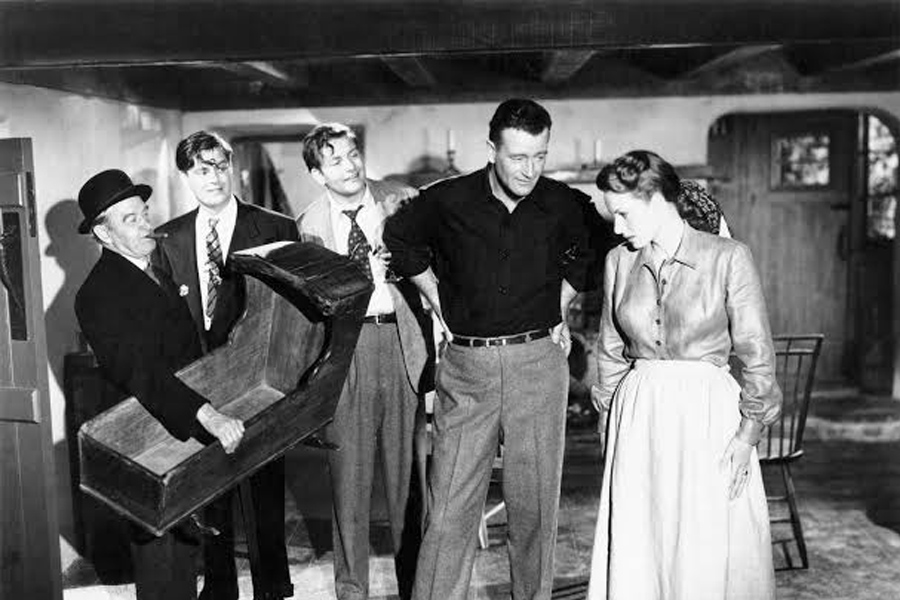
One of the pivotal moments in Charles Fitzsimons’s life came in 1951 when director John Ford was preparing The Quiet Man in Ireland.
Through his sister Maureen, Charles became connected with the production. He initially worked in a legal and location capacity and also appeared in the film as Hugh Forbes.
The Quiet Man became one of the defining films associated with Maureen O’Hara and John Wayne, and it also marked an important turning point for Charles. His experience on the production helped establish his connection with American filmmaking.
After the film, Charles emigrated to the United States, with his brother James also making the journey. Hollywood became more than a destination. It became the setting for the rest of his professional life.
From Actor to Hollywood Producer
During the 1950s, Charles Fitzsimons continued acting while gradually moving toward production and executive work. His screen appearances included Against All Flags, Les Misérables, Titanic, The Desert Rats, The Black Shield of Falworth, Captain Lightfoot, and The Last Hurrah.
His role in Titanic was particularly notable because he portrayed Chief Officer Wilde. His acting career, however, was only one chapter.
He increasingly worked behind the scenes, where his legal background and knowledge of production gave him a distinctive advantage. He became involved in production supervision and eventually moved into producing and executive positions.
Among his production credits was The Deadly Companions, released in 1961 and starring Maureen O’Hara. The film was directed by Sam Peckinpah in his feature directorial debut. Charles helped establish Carousel Productions for the project, produced the film, and also co-wrote its theme song.
His career later expanded into television, where the sheer volume of his work became remarkable.
A Long Career in Television
Charles Fitzsimons worked across a broad range of television programs and production formats. His credits included Nanny and the Professor, Wonder Woman, The New Adventures of Wonder Woman, Love, American Style, Matt Helm, The Green Hornet, and the 1980s television series Casablanca.
He also worked on television movies and pilots, including The Red Badge of Courage, Children of Divorce, Elvis and the Beauty Queen, and Police Story: The Freeway Killings.
His career summary encompasses roughly eight theatrical features, 15 television movies, 14 pilots, 177 one-hour television episodes, and 94 half-hour episodes. Those numbers illustrate the scale of his work better than any single credit can.
He also served as an executive assistant to producer and aviation pioneer Merian C. Cooper. That association brought him into complicated production and rights matters, including issues surrounding the King Kong property.
In 1962, Charles became a naturalized American citizen, cementing the transition from Irish theatrical hopeful to established American entertainment executive.
Charles Fitzsimons and Maureen O’Hara
Charles and Maureen shared more than a family name. Their professional lives frequently overlapped.
He managed aspects of Maureen’s career and acted as her attorney during her legal battle against Confidential magazine in 1957. The lawsuit concerned false allegations published about the actress, and Maureen ultimately prevailed.
Their relationship illustrates one of the less visible sides of Hollywood families. While Maureen appeared before cameras, Charles often worked behind them, dealing with legal, business, and professional matters.
Their partnership was not simply that of a famous actress and her brother. It reflected a family tradition in which talent was accompanied by practical knowledge and determination.
Leading the Producers Guild of America
Charles Fitzsimons became a key Producers Guild of America administrator.
Executive director from 1981, he retired in 1999. During those 18 years, he helped producers improve their professional status and clarify producer credits.
The Screen Producers Guild was founded in 1950 by film producers. In 1957, television producers founded the Television Producers Guild, which merged with the Producers Guild of America in 1962.
Charles took over the company when the entertainment sector changed. Television was growing, independent production was growing, and producer recognition was getting more problematic.
Charles wanted producers to be treated equally with other creative groups. Clearer credit standards were also stressed.
He won the Guild’s first Lifetime Honorary Membership Award in 1989 or 1990. After renaming the award the Charles B. FitzSimons Award, his name became synonymous with the organization he helped build.
The Producers Guild After the Fitzsimons Era
The Guild continued to evolve after Charles retired. The organization expanded its representation of the broader producing community and later incorporated the American Association of Producers in 2001.
Its work grew beyond traditional theatrical and television production. New media, digital entertainment, games, web production, visual effects, sustainability, education, mentoring, and professional standards became increasingly important.
The Producers Guild Awards also became a major annual event. The first Golden Laurel Awards were held in 1990, with Richard and Lili Fini Zanuck receiving the theatrical motion picture honor for Driving Miss Daisy. The awards were later renamed the Producers Guild Awards.
The Guild eventually introduced the Producers Mark, represented by the designation p.g.a., to identify producers who had performed substantial producing responsibilities on a particular film. The mark became an important mechanism for distinguishing actual producing contributions from nominal or contractual credits.
These developments reflect a larger Hollywood transformation, but they also echo an issue that mattered deeply to Charles Fitzsimons: recognition of the people who make productions happen.
Charles Fitzsimons and His Personal Life
Charles married Consuelo Vaughn, and the couple had four children before divorcing. He later married Cherie Bromley on May 26, 1978.
Charles and Cherie remained married until his death in 2001 and had one daughter together, bringing his total number of children to five.
The family generally maintained a private life. Public information about several of his children is limited, and the family did not cultivate the same level of public visibility associated with Maureen O’Hara.
One known child, Charles F. FitzSimons, born September 30, 1962, entered the entertainment business. He worked as an actor and production worker and appeared in or contributed to productions including Back to the Future Part II, Remote Control, General Hospital, The Fall Guy, and Police Story: The Freeway Killings.
Jaime FitzSimons is also identified publicly as one of Charles’s children, although comparatively little biographical information is available.
The Wider FitzSimons Family Legacy
The FitzSimons family story extends beyond Charles and Maureen. It is a story about a family in which artistic ability appeared repeatedly, but never in exactly the same form.
Peggy followed music and religious service. Maureen became a major film star. Clare acted before choosing family life. Margot pursued film acting and later settled into a quieter life. James became a working actor. Charles combined law, acting, production, administration, and professional advocacy.
Their careers resemble different branches growing from the same tree. The common roots were Dublin, music, theatre, discipline, and a household that encouraged creative ambition.
Charles’s own branch was unusually broad. He could stand on a stage, appear before a camera, examine a legal problem, manage a production, negotiate industry matters, and administer a major professional organization.
The Final Years of Charles B Fitzsimons
Charles retired from the Producers Guild of America in 1999 after nearly two decades as executive director.
He remained associated with an industry in which he had worked in almost every direction. His career had begun in Ireland and passed through acting, legal work, film production, television production, studio administration, and guild leadership.
He died on February 14, 2001, in Los Angeles from liver failure. He was 76.
His funeral services were held at St. Martin of Tours in Brentwood. His family requested that people wishing to honor his memory consider donations to the Irish Sisters of Charity.
He was survived by his wife Cherie, five children, sisters including Maureen, and five grandchildren.
Charles B Fitzsimons Legacy in Hollywood
Charles Fitzsimons was not as famous as his sister Maureen, but his career was significant.
Multiple places bear his mark. It’s evident in his films, productions, television shows, legal and business work for entertainers, and Producers Guild institutional growth.
Behind the camera may have been his biggest influence. Film producers balance artistic, financial, legal, and logistical challenges without the public recognition of actors or directors. Charles spent most of his later career clarifying that function.
An Irish barrister who joined Hollywood through The Quiet Man had a lengthy career in American entertainment.
FAQ
Who was Charles B Fitzsimons?
Charles B Fitzsimons was an Irish-born American actor, attorney, film and television producer, and entertainment executive. He was also the brother of actress Maureen O’Hara and served as executive director of the Producers Guild of America from 1981 to 1999.
When was Charles B Fitzsimons born?
Charles Bernard FitzSimons was born on May 8, 1924, in Ranelagh, Dublin, Ireland.
When did Charles Fitzsimons die?
Charles Fitzsimons died on February 14, 2001, in Los Angeles, California. He was 76 years old.
Was Charles Fitzsimons related to Maureen O’Hara?
Yes. Charles was the younger brother of Maureen O’Hara, who was born Maureen FitzSimons. He also worked professionally with her at various points in her career.
What did Charles Fitzsimons do in The Quiet Man?
Charles worked with John Ford’s production of The Quiet Man in Ireland in 1951 in a legal and location capacity and also acted in the film as Hugh Forbes.
Did Charles Fitzsimons practice law?
Yes. He studied legal, political, and economic science at the National University of Ireland and completed his Barrister-at-Law degree at King’s Inns. He subsequently used his legal knowledge in Hollywood, including professional work for his sister Maureen O’Hara.
What films did Charles Fitzsimons act in?
His acting credits included The Quiet Man, Against All Flags, Les Misérables, Titanic, The Desert Rats, The Black Shield of Falworth, Captain Lightfoot, and The Last Hurrah, among others.
What was Charles Fitzsimons’s connection to The Deadly Companions?
Charles produced The Deadly Companions, a 1961 Western starring Maureen O’Hara and directed by Sam Peckinpah in his feature directorial debut. Charles helped establish Carousel Productions for the film and co-wrote its theme song.
How long did Charles Fitzsimons lead the Producers Guild of America?
He served as executive director of the Producers Guild of America from 1981 until his retirement in 1999, a period of approximately 18 years.
What award was named after Charles Fitzsimons?
The Producers Guild’s Lifetime Honorary Membership Award was later renamed the Charles B. FitzSimons Award in recognition of his contribution to the organization.
How many children did Charles Fitzsimons have?
Charles Fitzsimons had five children. Four were from his first marriage to Consuelo Vaughn, and one daughter was born during his marriage to Cherie Bromley.
Was Charles Fitzsimons wealthy?
There are no reliable public figures establishing his personal net worth or detailed estate value. He had a long and established Hollywood career, but his personal financial circumstances remained private.
What happened to the FitzSimons family after Charles’s death?
Members of the family largely maintained private lives. Maureen O’Hara remained the best-known public figure among Charles’s siblings, while several other FitzSimons family members pursued acting, religious service, or family life. Charles’s son Charles F. FitzSimons also worked in the entertainment industry.
Available next action: Create a downloadable DOCX file here in this chat containing the editable prose above